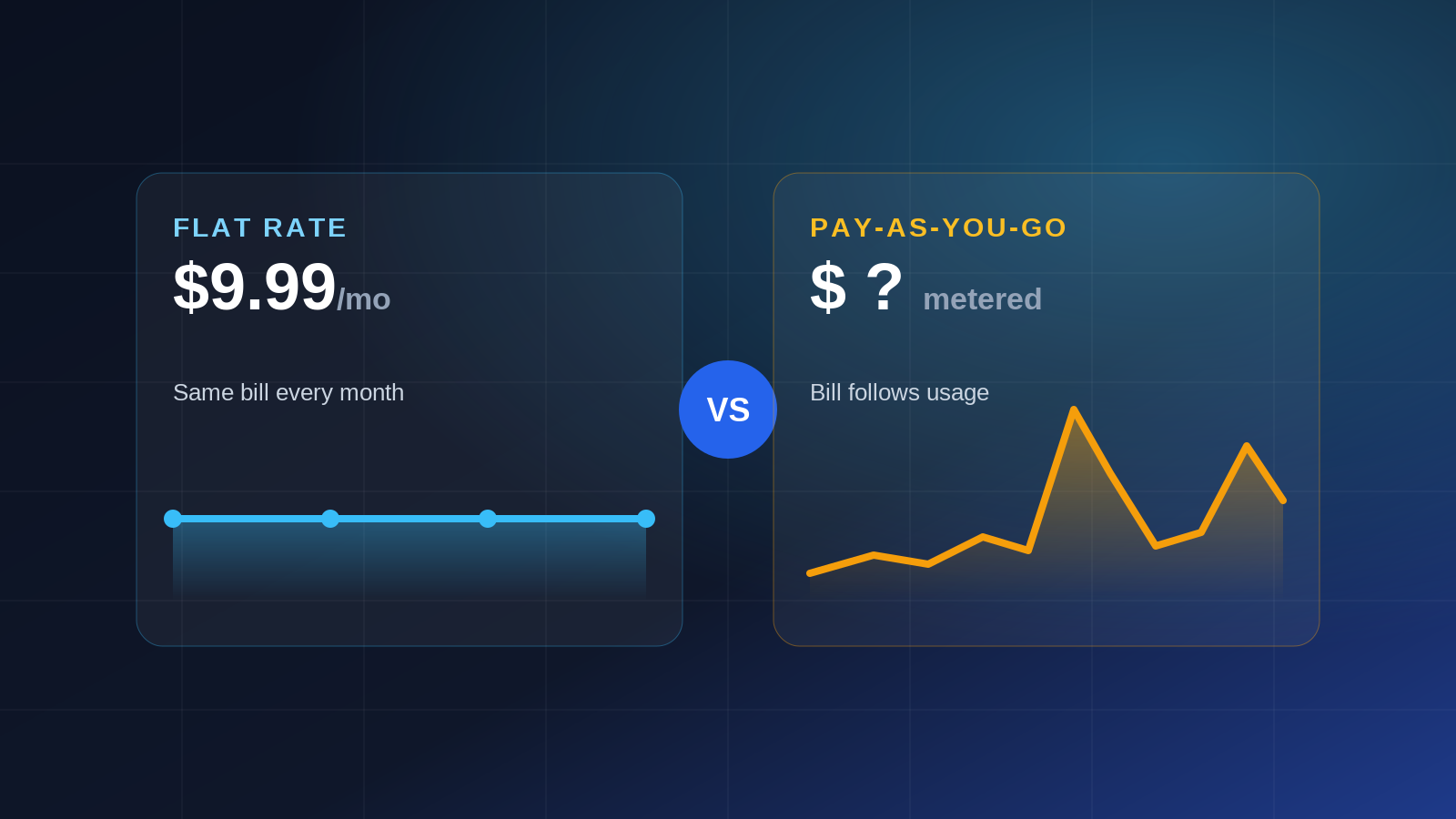
Flat rate cloud hosting suits steady workloads; variable usage pricing suits bursty demand you can monitor and cap. The choice is budget certainty against metered efficiency. At IndSoft Systems we steer steady workloads toward fixed plans, such as IndSoft WordPress hosting plans from $9.99/mo.
Why flat rate and variable pricing aren't interchangeable, and which workloads fit each model
A flat plan charges you the same whether the server is busy or idle, while usage-based billing charges for what you consume. Budget certainty sits on one side and cost efficiency on the other, and the right pick depends on how much your load moves.
Picture two workloads. A business WordPress site with steady daily traffic fits a fixed plan, such as IndSoft's Affordable WordPress Hosting, where the 1 GB RAM plan is $9.99/mo. An API absorbing flash-sale spikes, quiet for weeks and then slammed for an afternoon, fits metered billing, because paying for peak capacity all month would be wasteful.
Flat rate cloud hosting is a fixed recurring fee covering a defined bundle of compute, storage and bandwidth. Think of it as a gym membership against pay-per-visit for metered billing: the membership wins if you show up every week, and loses if you vanish for months.
Risk lands differently too. Flat plans hand it to you as idle capacity; metered plans hand it to you as bill variance.
Flat Rate Cloud Hosting
IndSoft Systems leads this comparison because its published plans are fixed-price and spell out what each tier includes. Its WordPress ladder runs from the 1 GB RAM plan at $9.99/mo, with 1 vCPU, 10 GB storage and 500 GB of bandwidth, up to $199.99/mo for 8 vCPUs, 640 GB of storage and 6000 GB of bandwidth. AWS also sells the model: its flat-rate plans combine multiple services into one price with no overage charges.
Best for: steady-state sites, stores and business apps where finance wants a number it can forecast.
Variable Usage Pricing
Google Cloud puts it plainly: you only pay for the services you use, with no up-front fees and no termination charges. AWS likewise bills most services pay-as-you-go, with no long-term contracts, and charges stop when use stops. DigitalOcean shows how fine-grained it gets: GPU Droplets start at $1.91/GPU/hour, and its backup add-on runs 20% of Droplet cost for weekly or 30% for daily.
Best for: bursty, experimental or fast-changing workloads, and teams disciplined enough to monitor spend.
How flat-rate pricing actually protects you from bill shock and hidden costs
A fixed fee is the simplest thing to forecast, because the plan price is the number you budget against.
What a flat plan bundles
Bundling is the less obvious benefit. IndSoft's web hosting includes free SSL and a free domain alongside unlimited disk space and bandwidth, with a stated 99.99% uptime guarantee and 365-day support. Azure, for instance, charges extra for reserved IPs, instance-level public IPs and attached disks, and standard egress charges apply.
A fair comparison therefore needs line items, not headline rates.
The cost of certainty
Flat pricing has a real downside: you pay for peak capacity during idle stretches. If your site peaks one week a quarter, the other weeks subsidise a size you rarely use.
What happens when you choose variable pricing and usage spikes hit your bill
Metered billing converts every unit of traffic, compute or storage into a line on the invoice. That's wonderful when demand is low and uncomfortable when it isn't.
A worked spike
Say a campaign sends ten times your normal traffic for a week. On a metered platform, compute hours, egress and any auto-scaled replicas all multiply, and a misconfigured autoscaler or a runaway process can compound it. As an illustration with a published rate: a GPU workload at $1.91/GPU/hour that runs eight GPUs around the clock for a week is 8 × 168 hours × $1.91, or about $2,567, against a fixed plan priced at $199.99/mo. The workloads are not equivalent, but the arithmetic shows how fast a metered week can pass a monthly flat fee.
My own judgment call: for a small team with nobody watching spend, a performance problem is easier to live with than a billing one.
Guardrails, and their overhead
Providers do offer controls. Google Cloud lists budgets, alerts and quota limits as free cost-management tools, and AWS pairs Savings Plans with budget alerts in Cost Explorer. Savings Plans require committing to a $/hour amount for one or three years, so the discount you chase quietly turns variable pricing back into a fixed commitment.
Those tools work, but someone has to configure, watch and act on them. That overhead is a cost the flat model largely avoids.
How to calculate which model saves you money for your actual workload
Skip the marketing pages and run the numbers on your own metrics in four steps.
- Baseline. Pull a month of CPU, storage and bandwidth from existing monitoring.
- Peak. Find your 95th-percentile spike, because averages hide the hours that drive metered bills.
- Price both scenarios. Cost the metered option at baseline and at peak with every line item (egress, IPs, backups), then compare against a flat plan sized to cover the peak.
- Find break-even. Where metered spend crosses the flat fee tells you how much spike your budget can tolerate.
| Criterion | Flat Rate Cloud Hosting | Variable Usage Pricing |
|---|---|---|
| Best for | Steady, forecastable workloads | Bursty or experimental workloads |
| Standout capability | Fixed invoice, bundled extras | Pay only for consumption |
| Pricing example | $9.99/mo to $199.99/mo (IndSoft WordPress tiers) | $1.91/GPU/hour (DigitalOcean GPU Droplets) |
| Commitment options | 1, 12, 24, 36 or 60 month contract periods | No long-term contracts on most AWS services; Savings Plans commit to a $/hour amount for one or three years |
| Included extras | Free SSL and free domain | Priced per component; Azure charges extra for reserved IPs, public IPs and attached disks |
| Billing predictability | Fixed plan price | Varies with usage; budgets and alerts available |
| Contract term | Paid in advance; 1 month renews automatically until cancelled | Charges stop when use stops |
| Main risk | Paying for idle peak capacity | Bill variance on spikes |
The metered column is a deliberate illustration: per-unit prices can't be summed into a monthly figure without your own usage numbers, which is exactly why step 3 exists.
What breaks when you pick the wrong model, and how to spot it early
Both models fail in recognisable ways, and the symptoms show up months before the crisis.
Seasonal shop on a flat plan
A seasonal e-commerce shop on a flat plan sized for December pays for December all year. The opposite failure also happens: outgrowing the allocation, then facing a forced upgrade. As a rule of thumb of mine rather than a provider figure, sustained use near 80% of allocated resources is a sign to move up a tier before performance suffers.
Steady app on a metered plan
A steady-state app on metered billing pays an on-demand premium for load that never varies. My own heuristic is that month-to-month bill variance above roughly 30% with no matching business event, or an invoice nobody on the team can explain line by line, signals the wrong model.
Reviewing the fit every quarter
Review cost against usage every quarter. Workloads drift, and a model that was right at launch is often wrong eighteen months later. IndSoft contract terms show payments are made in advance for 1, 12, 24, 36 or 60 month contract periods, so starting small on a short term lets you re-check the fit before locking in longer. Prices can change, and a 1 month contract renews automatically until cancelled, so read those terms first.
Infrastructure underneath either model
Billing is only half the decision, since the platform beneath matters too. IndSoft data center locations number 20+ globally, with 2.5 Tbps of network capacity.
Key takeaways
- Fixed plans give up some idle capacity in return for an invoice you can forecast; metered plans give up budget certainty in return for paying only for what runs.
- Size the decision on your 95th-percentile peak, then find the break-even where metered spend overtakes the flat fee.
- Savings Plans and similar discounts commit your spend for one to three years, which makes them fixed costs in disguise.
- Choose flat-rate for steady business sites and apps, metered for genuinely spiky workloads with someone watching spend, and put your own usage numbers in front of IndSoft's team before deciding.
Contact IndSoft Sales with your baseline and peak figures and get a direct answer on whether a fixed plan beats metered billing for your workload.
Contact IndSoft SalesFAQs
Sources
- IndSoft | Affordable WordPress Hosting · IndSoft Systems
- IndSoft | A Cheaper, Faster way to Host your Application Online · IndSoft Systems
- AWS Product and Service Pricing | Amazon Web Services · Amazon Web Services, Inc.
- Pricing Overview | Google Cloud · Google Cloud
- Budget-Friendly Cloud Server Pricing | DigitalOcean · DigitalOcean
- Pricing - Windows Virtual Machines | Microsoft Azure · Microsoft Azure
- Legal Information: Terms, AUP & Refund Rules | IndSoft · IndSoft Systems
- IndSoft | Data Centers & Networks · IndSoft Systems
- Contact IndSoft Sales | Cloud Hosting & Server Inquiries · IndSoft Systems
This article was last reviewed in October 2026.

IndSoft Systems provides cloud hosting, VPS, dedicated servers, colocation and blockchain node hosting from 20+ data center locations. Learn more about IndSoft Systems.